
Technology
1. What is the NCT technology?
The Natural Cristallization Technology (NCT) means formation of an innovative binding agent, a catalyst for crystals formation.
The admixture of NCT is a catalyst for crystals formation, stimulating a reaction with water and components dissolved in it (e.g., calcium hydroxide, mineral salts, mineral oxides, anhydrous and partly hydrated cement particles) in damp mineral construction materials. Its result is an insoluble crystal, of a composition resembling a normal cement stone, but of a totally different crystalline structure (see photos).
The significantly magnified photographs below were taken with a scanning electron microscope, and they show changes in the wall structure following treatment with NCT.

Photograph 1: An electron microscope photograph of a 5 µm wall cross-section surface of standard concrete, with no NCT added. Regular components can be seen, together with additional lime and cement moistening products.
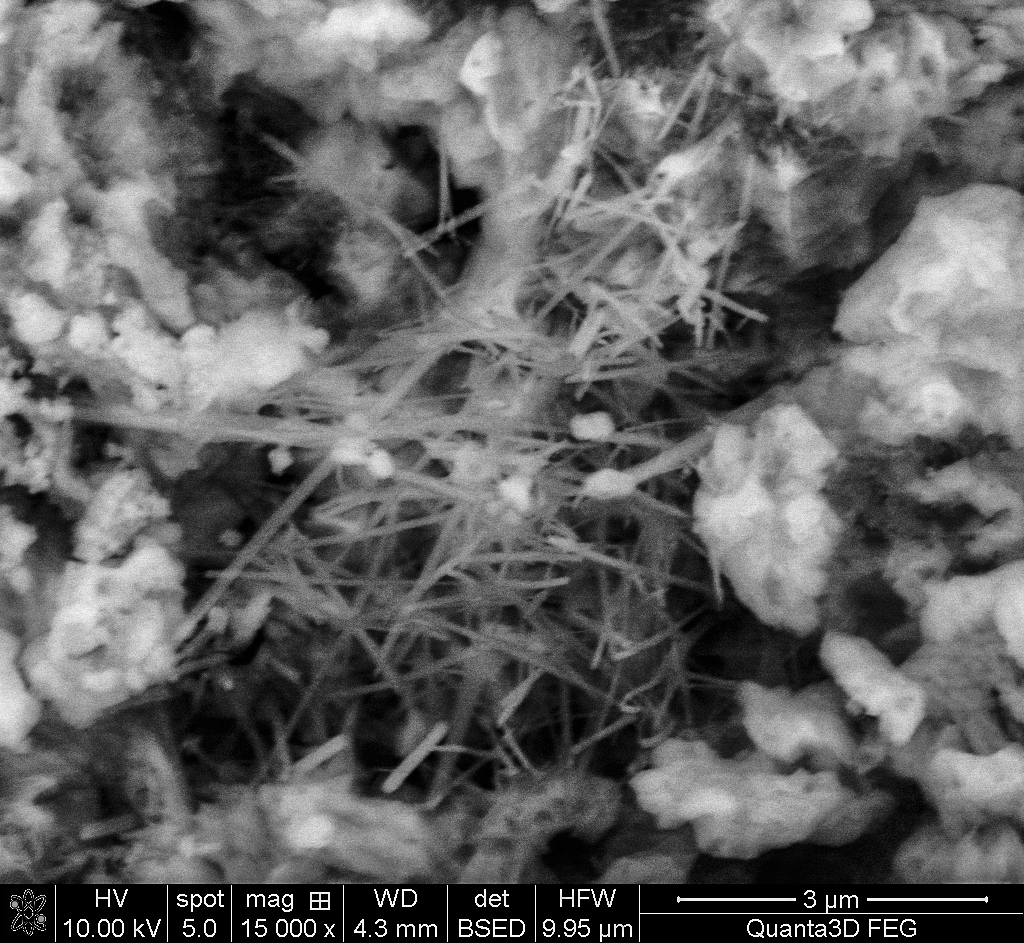
Photograph 2: A photograph of 3 µm wall surface under an outer layer of concrete with the NCT admixture. Image after 7 days.
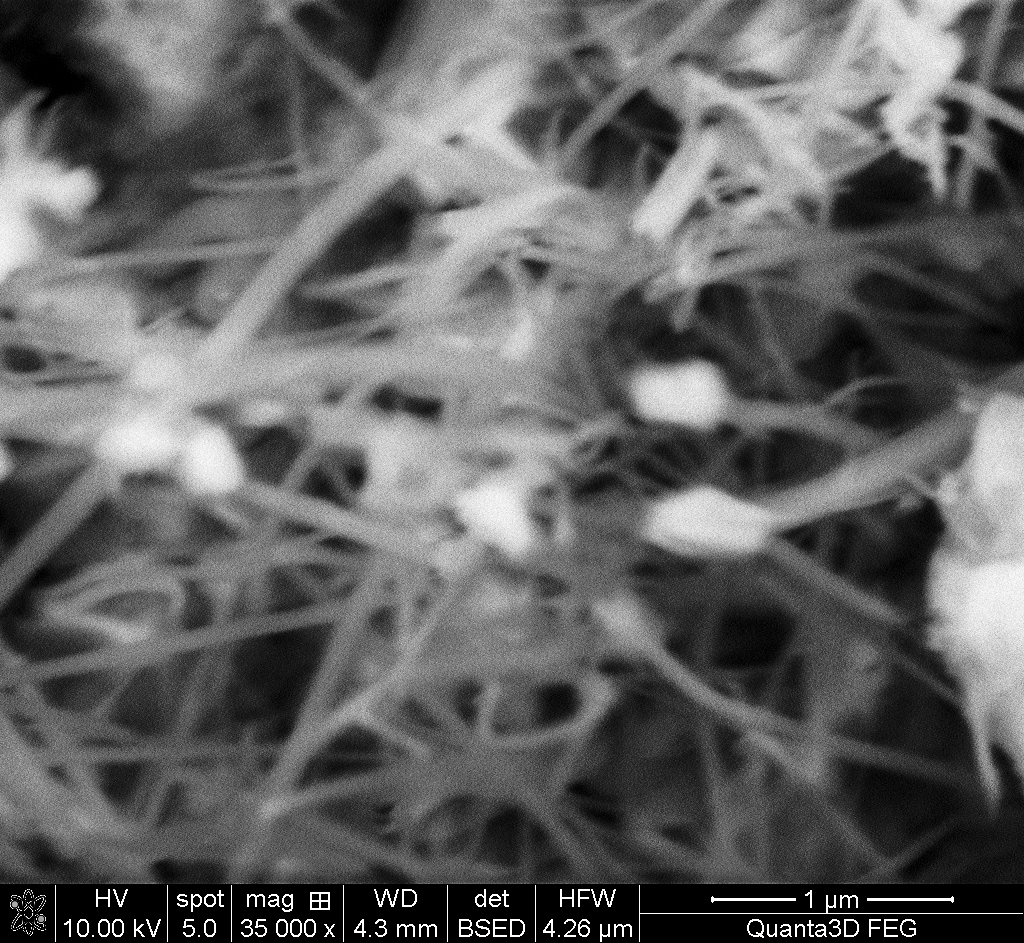
Photograph 3: A photograph of 1 µm wall surface under an outer layer of concrete with the NCT admixture. Image after 28 days.
In contact with water, NCT crystals continuously absorb dissolved components into the crystalline structure, and thus grow continuously. This is a quite important reason for a high NCT performance. The crystal formation catalyst begins sealing, and sources for "material" for further sealing are practically limitless in damp construction materials.
As it is shown in the Figures, with this spontaneous growth inside moistened capillary pores a crystalline structure is created, which in time achieves such a high structural density that liquid water cannot penetrate it any more. As water is necessary for "material transport", so with drying of capillary pores also the growth of crystals is inhibited. However, when by external influences, including new cracks caused by settling or increased water pressure in the future, water penetrates these capillary pores again, then crystals are formed again.
Thus, NCT sealing remains active for many years and is able to spontaneously react to changes inside and outside of a construction component. In time and depending on a size and the NCT concentration, the NCT crystalline structure inside the capillary pores achieves a density that is waterproof on one side, while remaining diffusively open on the other.
It was found in engineering evaluations that use of NCT in a construction material such as concrete or a brick wall reduced macropore volume by 97%.
The NCT admixture consists of Portland cement and mineral additives. Selected mineral components, including sulphur, copper, soda, water glass, have anti-bacterial properties and prolong life of products treated with the NCT method. All traditional construction materials are manufactured on a basis of petroleum organic binders. These products are particularly susceptible to micro-organisms. The name Nano-Cement Technology was developed during nanotechnological studies, and is known as the Natural Crystallization Technology. A grain size of this binder corresponds to coarse grains of Portland cement (a grinding grade below 3000 cm2/g). On request, we can manufacture liquid NCT binders, with no cement added. These agents should be compared to binders from the Roman times. Roman constructions do not contain cement, and were erected using lime and a mineral crystalline binder.
What does the NCT binder consist of?
It is an inorganic material based on Portland cement and mineral fillers having a capillary effect, and when cement, lime and water is present in concrete capillaries, formation of water-insoluble crystals is initiated lasting as long as there is any moisture available. This binder requires a water-saturated substrate, enabling quick penetration of minerals into the wall or concrete.
The agent increases water density in concrete, cement and sand mortar, and lime mortar, as well as in other porous materials, such as old bricks. This is the only inorganic cement admixture manufactured similarly to diamond crystals, so it is practically indestructible (see http://www.youtube.com/watch?v=ewpZmlTDFp8). This short video presents the following issues: balanced mass to energy conversion creates a strong and stable - balanced - elementary structure, a matrix, resistant even to extreme heat exposure (2400°C).
The message of this video is: minerals of a specific composition, with a blue shift deficit (an electron process) fully use an excessive blue shift of water molecules. Normally, we would say they "use their electron orbitals frequently". The established balance of proton mass to energy conversion, and then energy to mass conversion in neutron processes creates nearly indestructible elementary matrix. (Of course: compensation is not complete, as the law of entropy increase is an important aspect!)
Produced concrete bound with cement resists extreme mechanical and thermal phenomena. The improved balance of mass to energy conversion processes in the elementary matrix does not require external energy. Thus created balance acts as a shield: protects outside (similarly as nature in a case of diamonds) due to the blue shift.
When one side of a concrete slab is strongly heated, its other side remains cold for a long time. After some time water "used" earlier will be released. At this point the external energy combats the internal energy. And water, as newly formed in the structure, simply flows out. Without any vapour, thus proving the temperature remained low.
The elementary communication was driven by electron processes in the mixture components. In all elementary processes it is crucial that molecules naturally strive to achieve optimal (the most perfect) balance between both parts.
The composition of the above-mentioned mixture also ensures that the receiving part, with neutrons dominating, has a deficit in electron processes, and the active part, with protons dominating, exhibits an excess in electron processes.
This "NCT matrix" is of importance for solving the case of Fukushima disaster. Since 2012, a decontaminating agent, NCT DECON, is being tested in Japan.
NCT as an anti-corrosion agent
It reflects the strength properties of concrete and improves it, increasing its resistance to cracking. Through hydration stratification it penetrates into concrete, inhibits corrosion processes and makes concrete resistant to aggressive chemical agents affecting the structure through environmental processes. This substance is used as waterproof mortar, sealing mortar, and mortar for protection and repairs, as well as an additive to concrete mixtures (depending on the component type).
The 3–5mm-thick NCT layer applied on new or old concrete penetrates to the depth of 50 to 150mm, making concrete 100% more resistant to effects of water, sea water, oils, acids and other chemicals. This is an ideal mortar for repairs of old, corrodedconcrete structures of buildings, bridges, tunnels, sewage systems, and similar.
How does NCT work:
It is explained by a simple change in a sequence of reaction stages occurring in cement:
- penetration in old concrete, wall
- Anything that can be dissolved, is dissolved to a maximum extent possible
- Attacking and filling empty spaces in concrete or a wall. Then hardening into a uniform monolith.
Following the chemical reactions, cement is additionally hydrated; hardly soluble new components are formed, filling capillaries, pores and microcracks and binding lime in concrete forming insoluble solids (gel).
Traditional concrete contains about 70% of macropores and 30% of micropores, while concrete with NCT contains 97% of micropores and only 3% of macropores. This makes it resistant to water and other aggressive liquids. An artificially reduced pore diameter is not much larger than a water molecule diameter. This way a molecular sieve is formed, impermeable to large molecules such as pressurised water, rainwater, organic acids, alkaloids, fats, and similar. When the pore diameter is reduced, the pressure of liquids and gases inside pores increases, preventing further penetration of gases, water and electrolytes.
Natural Crystallization Technology (NCT) is, first of all, an environmentally friendly technology and a new way of thinking in engineering; an option providing high quality and low costs, and prolonging life of old and new buildings. The renovation and refurbishment is usually very fasts resulting in very short times. The technical final result is much better than the one achieved with conventional (chemical) agents.
NCT can be used for numerous applications at a construction site, for:
- refurbishment and repairs of old, existing concrete, brick or stone walls;
- anti-corrosion and fireproofing protection for any wall, steel or even wood;
- improving and crystallisation of newly constructed concrete, screeds or prefabricate surfaces.
- NCT mortars control water content in old walls, that is, they prevent excessive damp or drying.
- NCT is a technology modifying structure of concrete or mortars in a natural way:
- increasing density
- increasing compressive strength and bending resistance, and protecting against chipping
- reducing water absorption and permeability in concrete
- increasing resistance to frost
- increasing resistance to wear
- increasing resistance to capillary absorption
- complete protection of reinforcing steel
- increasing adhesion to a substrate (for existing concrete, mortar or steel)
- increasing resistance to aggressive substances
- Concrete and mortars become inorganic, and this means elimination of hazardous to health chemical components from construction materials
- NCT materials have an effect on concrete and mortars at a molecular and energy levels, by:
- changing the molecular structure of concrete and mortars
- inducing minerals and water recrystallization
- causing complete cement hydration in new concrete
- activating rehydration of cement and mortars in old concrete and mortar
- This way additional bonds are formed in macropores and new molecules are formed, transforming them into micropores.
2. NCT TECHNOLOGY MEANS
VERSATILITY - it is used for production and improvement of concrete, mortars and concrete prefabricates, as well as for renovation of old buildings and restoration of historic constructions.
ENVIRONMENTALLY FRIENDLY - it is inorganic (mineral) and thus environmentally friendly, guarantees chemical neutrality, resulting in turn in impermeability and resistance to oils, acids, alkali and salts.
RENOVATION - improves all technical parameters of old and newly erected concrete, reinforced concrete, and masonry structures, so it can be used in new concrete, as well as for restoration, repair, and refurbishment of heritage buildings.
WATERPROOFING - renders concrete, reinforced concrete and all mortars permanently waterproof, ensuring waterproofing. It also holds a certificate of the National Institute of Hygiene for safety in contact with drinking water.
ANTI-CORROSION PROTECTION- protects reinforcing steel against corrosion due to low surface tension and oxidation of the upper steel structure. This way processes of concrete weathering and steel corrosion are effectively inhibited.
3. NCT CEMENT REACTION WITH CONCRETE, OR BRICK OR STONE WALL
NCT forms a monolith with existing material. It fills spaces between molecules.
Supersaturated solutions are created. They form new hydration components, thermodynamically more stable. They are characterised by lower solubility, larger surface, and high strength.
4. EFFECTS OF APPLICATION
- Increase in standard concrete density by maximum 25% (e.g., bulk density of 2000kg/m3 - increase to 2500kg/m3) means increase in strength.
- 100% resistance to fresh, sea and soil waters, resulting from increased concrete density and forming of 0.006-mm-thick layer of oxides with NANO-CEMENT. This layer is resistant to chlorides and sulphides penetration
- Increase in material flexibility by 15% to 20%
- Increase in structures and monoliths resistance to cracking by up to 60% (very important for banks and bridges)
- Reducing concrete shrinkage by at least 50%
- Increasing concrete strength by ca. 50%, e.g., from B25 to B40
5. BENEFITS
- Water vapour diffusion
- 100% impermeability at 14 atmospheres (ca. 140m of the water column) for an at least 7mm-thick layer of mortar consisting of NCT CEM + NCT CRYSTAL
- Increase of resistance to frost to 150 cycles
- Improvement in anti-corrosion steel protection by 100%
- Increase in concrete compressive strength by at least 25% and wall compressive strength by at least 97%
- chemical resistance corresponding to pH 3 to 12, and resistance to mineral oils
- Elimination of polymer, fibre and other chemical additives
- Performance of works does not require additional occupational health and safety measures
- High adhesion to steel
- It is non-flammable, non-toxic, and non-explosive
- Generates a low voltage current. This way erosion and corrosion of steel rods caused by environmental effects on concrete structures are reduced.
- An atomic structures formed can prevent fungal, mould, bacterial and algae growth, thus protecting the building structure and improving atmosphere inside.
- Mortar and concrete with NCT can be mixed with salt water
- it is not classified as toxic (can also be used for drinking water systems), it cannot detach and water cannot penetrate it, it does not require protection against mechanical damage as NCT becomes an integral part of concrete

NCT - Technologie - PowerPoint Präsentation: